Better work, not better paperwork
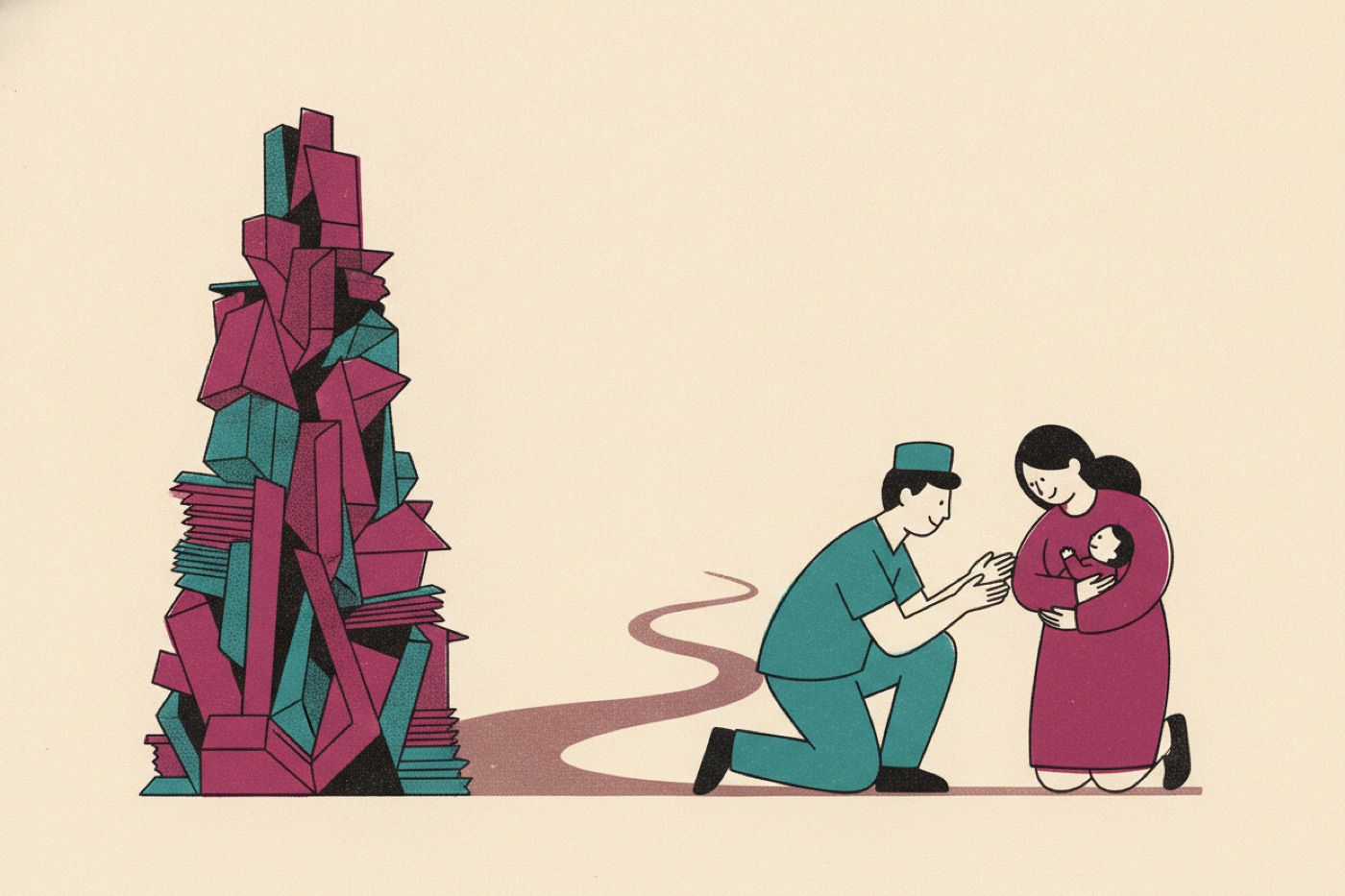
One of the best times in my career was working with community health workers in Zanzibar. We partnered with the government to build their community health system from scratch, and we were in the fortunate position of building it as a tech-enabled system from the beginning.
At the time, most digital health projects looked at how the health system already worked and tried to replicate it with technology. They translated the paper report into a digital data collection tool, or built a dashboard that exported the monthly government report. It saved a lot of time. But it didn't change how care was delivered.
At D-tree, our aim wasn't simply to make processes more efficient. Working hand in hand with governments, we wanted to transform how healthcare was delivered. Not a more polished report. We wanted to improve the lives of mothers and babies. We wanted a community health worker, someone with only a primary school education and no formal health training, to feel confident providing high-quality care to her neighbours, knowing she was providing the right care and building real relationships.
So instead of replicating the paper-based system, we took a step back and reimagined the workflow altogether. We started with the outcomes we wanted:
- Health workers with the confidence to provide high-quality care
- Community members who trusted their providers
- Less administrative work, with care first and reporting second
- Better health outcomes for mothers and babies
With that frame in mind, the data collection became a guided conversation about care following embedded decision support logic, with the data captured in the background. The supervision system stopped being a checklist and became interactive, flagging where a health worker was struggling and suggesting how to coach her. The dashboard stopped mimicking the government report and started showing the data that actually drove decisions, with the official report available as an export on the side.
The outcome we wanted was better care. Not better paperwork.
My focus has changed since then. I now help organisations build the operating systems they need to grow, with AI doing real work inside them. And I often find myself thinking about my time at D-tree, because most of the teams I talk to are approaching AI the way so many approached digital health in the early days. They look at the system they already have and build tools to replicate it, dropping an automated step where a person used to be while keeping all the other steps the same.
I think that's a missed opportunity.
McKinsey's 2025 State of AI found that 88% of organisations use AI in at least one business function, but only 21% have redesigned even a small part of a workflow around it. Nearly 80% are layering AI on top of how the work already gets done.
What's more striking is the gap in results. The small group actually seeing financial returns from AI are nearly three times more likely to have redesigned the work: 55% of them have, compared to 20% of everyone else.
The same pattern shows up at the individual level. Microsoft's 2026 Work Trend Index identified a group they call Frontier Professionals, the 16% of AI users who have moved beyond using AI to actively directing it. They design the process, set the quality bar, and manage AI the way they would manage a team member. 80% say they're producing work they couldn't have done a year ago.
A small minority is producing more work, and better work. They got there by changing the work itself.
So, instead of asking which tool we could use or which process we could automate, I look first at the outcome we're after. What are we actually trying to achieve? And then, from a blank page: what could be possible if AI were part of how we got there from the start?
Here is what that looks like in practice.
Donor reporting
Most nonprofits juggle multiple donor reports through the year. The typical way to bring in AI is to write a prompt that knows the format and what the donor is looking for. Someone drafts the report, pastes it in, and AI suggests edits. That saves time.
But what if you redesigned the workflow entirely?
Every team call about a project gets transcribed. Every document saved to the project folder gets reviewed. AI synthesises all of it as the work happens, tracking against the donor's requirements and building the narrative in real time. It knows when the next report is due. By the time you sit down to draft, you already have a solid first pass.
The review and the editing are still yours. The work of assembling the report from scratch is gone.
That isn't a faster version of the old workflow. It's a different one altogether.
Business intelligence
Every week, I need to stay current across AI, operations, and the fractional COO space. The old approach was to monitor podcasts and newsletters when I could and synthesise the insights myself.
Now, every Sunday at 2pm, three agents scan dozens of sources: podcasts, newsletters, publications, reports. A scoring agent rates each item from 0 to 3 across three categories. Anything scoring 2 or higher goes to a synthesis agent, which reads the full text, summarises it, and analyses it against my strategy and the specific questions I'm working through, along with suggested content, possible builds, and ideas for problems I'm solving with clients. By Monday morning, a 10-page brief is waiting in my inbox. I don't monitor anything. I read the output and decide what to act on.
I'm not the researcher anymore. I'm the decision-maker reading what the researcher produced.
Task execution
Most of what I do now is set direction. I define the outcome, work with the team and with AI as a thought partner to redesign the workflow, give AI the context it needs, and it executes. I review and revise before anything goes out.
This week, AI reformatted a set of budgets into a standard template, drafted a survey straight into Google Forms, and rebuilt a filing system, most of it while I was working on something else. At any given moment I have three or four tasks running in parallel, and I move between them to review, give feedback, and finalise.
I haven't outsourced my thinking. I set the strategy, I decide what good looks like, and I review everything before it's final. It takes a lot of attention, and providing the right context is critical for a good outcome. What I have handed off are the hours that used to disappear into pulling up a site, hunting for information across six documents, and structuring a blank page from nothing. Those hours are back in my day.
I used to be both the strategist and the executor. Now I'm mostly the strategist.
At D-tree, we weren't trying to make paperwork faster. We were asking what a different kind of care could look like, and then building toward it. It was hard, and it took years. But the work we started in Zanzibar more than ten years ago is now a nationally scaled, government-owned program, fully integrated into the health system, with demonstrated improvements in maternal and child health and early childhood development outcomes.
That same question is sitting in front of every team thinking about AI right now. You can use it to speed up the work you already do, or you can use it to ask what the work could become. The data already shows which group is pulling ahead.
This is the place I want to be, and what I want to help others to reach. So when I sit down with a team, I don't start with the tools. I start with a blank page and the question that has guided me since Zanzibar: not how do we make this faster, but what are we really trying to achieve, and what becomes possible if we build toward it from the start.
This is one piece of my AI operating system.
I write about building it, in public, in my newsletter AI on Purpose.
Subscribe to AI on PurposeLeading a team? Here's how I work with teams.